Life Line on the Palm: Meaning, Depth, Curve and Breaks
The life line is read for energy and resilience, not lifespan — what its depth, curve, ending and breaks mean
Where is the life line?
The life line starts between the thumb and index finger and curves down around the fleshy base of the thumb (the Mount of Venus), ending near the base of the palm. It usually shares its starting point with the head line and is the most visible curve on the palm.
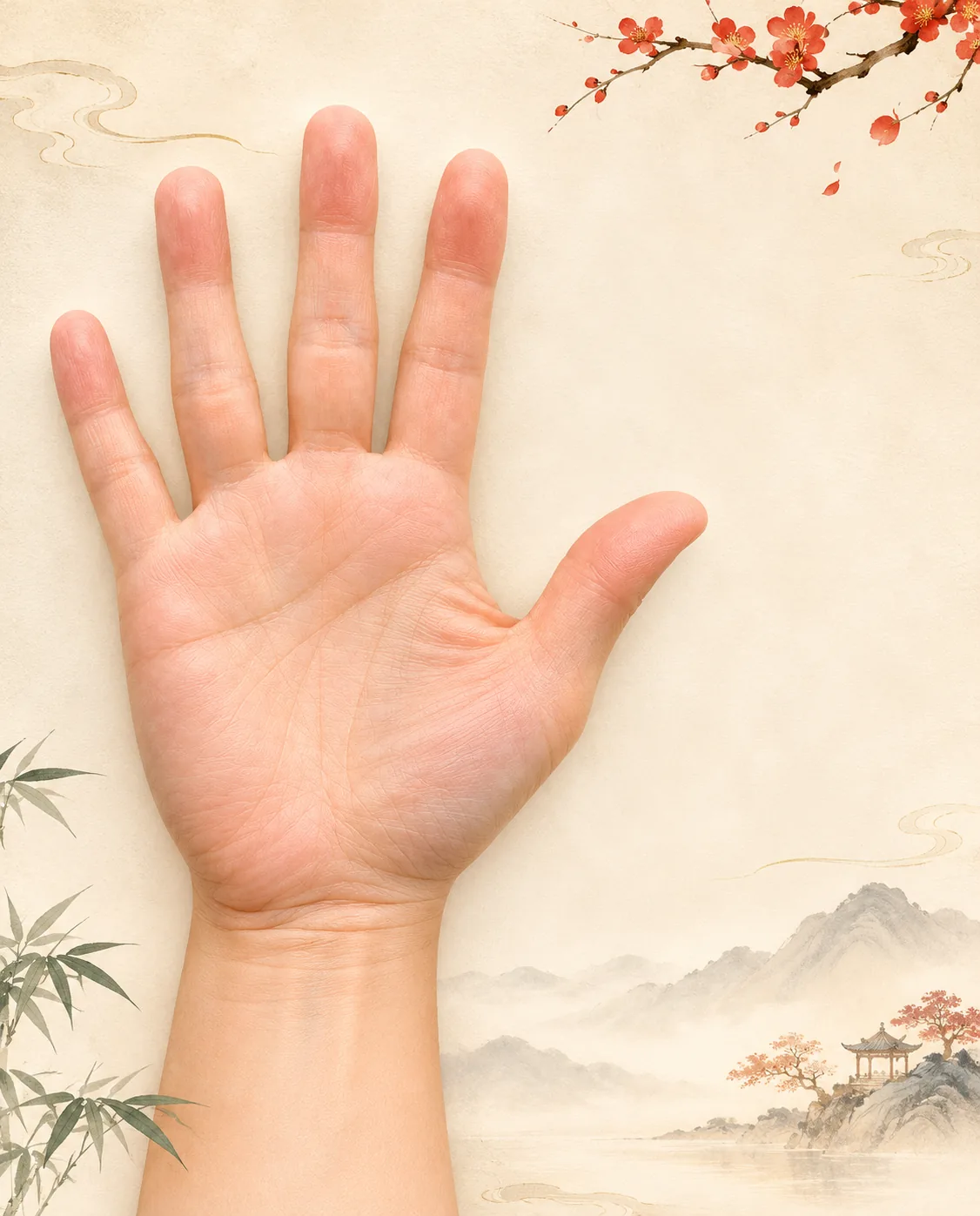
- 1Life line
- 2Head line
- 3Heart line
- 4Fate line
- 5Sun line
- 6Marriage lines
- 7Health line
- 8Wrist lines
Depth and clarity
This is what palm readers look at first. A deep, clear life line is traditionally read as plenty of energy and quick recovery — tired one day, back to normal after a night’s sleep. A faint line suggests energy worth pacing: after a few long days, your body complains sooner than most, and those who rest well go further.
A chained life line (made of small linked segments) is traditionally read as a sensitive constitution that benefits from regular sleep and meals.
Curve: wide or narrow
A wide curve that swings well into the palm, giving the thumb base plenty of room, is read as strong drive, warmth and the ability to carry a lot. A narrow curve that hugs the thumb suggests a more reserved nature that values stability and steady progress.
Start and end points
A high start near the base of the index finger is read in modern palmistry as self-control and ambition; a low start as a quicker temper.
Ending at the centre of the palm base suggests a later life centred on home and roots; curving back toward the thumb, a love of home and security; a branch reaching toward the outer lower palm (the Mount of Luna) is popularly read as an affinity for travel or living far from home.
Breaks, islands and double life lines
Broken with overlap: another segment picks up where the line breaks — traditionally a change of circumstances or pace that you handle smoothly.
Broken without overlap: a period of bigger change; give yourself more room then. It is not a bad omen and cannot predict specific events.
Island: a small oval on the line, popularly read as a tiring stretch that calls for rest.
Double life line: a parallel fine line inside the life line, read as extra resilience — sometimes called a helper line.
Crossing lines: fine lines cutting across the lower part are popularly read as a busy middle life, often carrying others’ loads.
Can the life line show age?
One timing school measures ages along the life line (roughly 15 below the centre of the index finger, 21 below the gap between index and middle fingers); another uses the fate line. They disagree, and both depend heavily on photo angle. Tideris readings do not compute ages from line positions; life stages follow the three palace areas described in the classical Chinese text Shen Xiang Quan Bian.
To see which kind of life line you have, try AI palm reading — the photo check is free and the reading covers your life line on its own. For the other lines, see palm line meanings.
Life line FAQ
Does a short life line mean a short life?
No. There is no link between the length of the life line and lifespan — modern palmistry books broadly agree. The life line is read for energy and resilience; a short but clear life line can simply mean focused, fast-paced energy.
What does a broken life line mean?
If another segment overlaps the break, it is traditionally read as a change of circumstances or pace that you handle smoothly. A clean break with no overlap suggests a period of bigger change, so give yourself more room then. It is not a bad omen and cannot predict specific events.
What does a double life line mean?
A fine line running parallel inside the life line is called a double life line or Mars line. It is traditionally read as extra resilience and staying power, and is sometimes called a helper line.
My life lines differ between hands — which counts?
A common view reads the left hand as what you were born with and the right as what you have built; Chinese tradition also reads the left hand for men and the right for women. The reading goes by the hand you photograph; a big difference can be read as your lifestyle making its mark.