Fate Line Palm Reading: Where It Starts, Breaks and Forks
The fate line shows whether your work has a main track and how your path unfolds — not rank or income
Where is the fate line?
The fate line runs up the middle of the palm, from near the wrist toward the middle finger. It is also called the career line. Unlike the life, head and heart lines, not everyone has one: some people have a clear line, some only a short stretch, and some none at all.
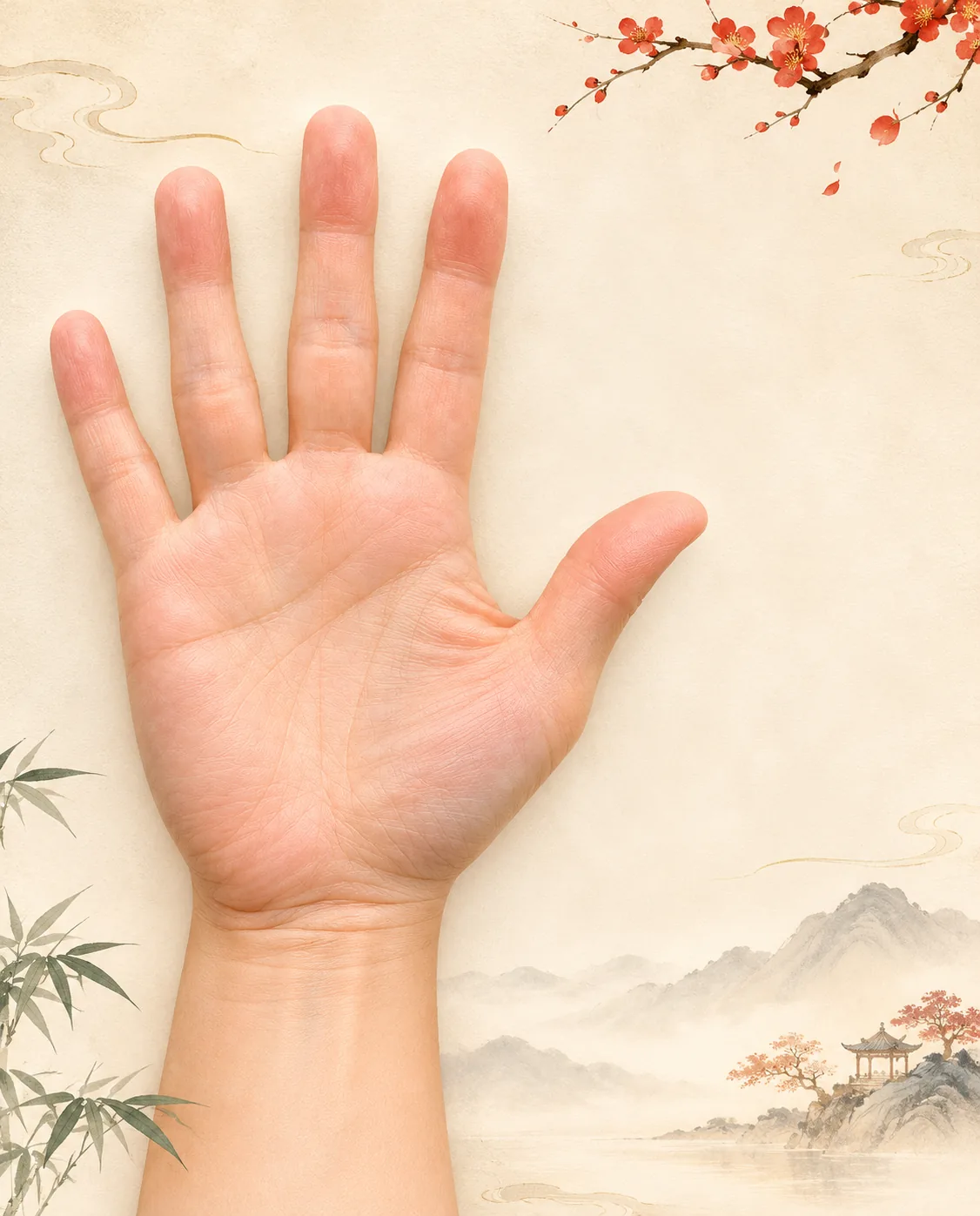
- 1Life line
- 2Head line
- 3Heart line
- 4Fate line
- 5Sun line
- 6Marriage lines
- 7Health line
- 8Wrist lines
Where it starts
At the centre of the wrist: traditionally read as setting your direction early and following your own plan.
Out of the life line: often read as strong support from family or people close to you at the start, before you go your own way.
At the outer edge of the palm (the little-finger side, near the wrist): popularly read as a start built on goodwill and other people’s recognition — suited to work with people.
Only in the middle of the palm: often read as finding your direction later, after trying a few paths.
Where it goes
Straight up to below the middle finger: your work has one main track, and you can stay on it.
Bending toward the ring finger: traditionally read as a later turn toward interests, reputation or a craft.
Bending toward the index finger: often read as wanting to lead and manage.
Stopping at the head or heart line: popularly read as a shift of focus away from career at some stage — not the end of a career.
Depth and length
A deep, clear fate line is traditionally read as a clear direction that grows steadier over time. A faint or patchy one suggests many ideas and a flexible path, adjusting as you go.
Length only shows how far the line runs across the palm. It does not show how big a career will be, and modern palmistry books do not judge success by it.
Breaks, forks and crossing lines
Broken but overlapping: traditionally read as one change of direction — a new field, a new city or working for yourself — that connects well.
Broken without overlap: often read as a period of big change; leave yourself some room. It is not a bad omen.
Forked end: popularly read as two paths open at once; side work is possible.
Crossed by small lines: often read as outside distractions in that period; ask one more question before deciding.
Is it bad to have no fate line?
No. Many people have no fate line. Traditionally it means your path is not set for you: changing fields, side work or working for yourself are all possible, and success comes from skill rather than position.
Read it with the other lines
The fate line alone cannot describe a career. The head line shows how you think, the sun line whether your work gets noticed, and hand shape and fingers how you work. Chinese palm reading also brings in the Five-Element hand type and the solar months, to see when in the year to push ahead and when to hold back.
Take a photo with AI palm reading to have your fate line read alongside the rest of your palm. For the other lines, see palm line meanings, the life line and marriage lines.
FAQ
Can the fate line change?
Yes. Minor lines change more than the three major lines; the fate line can grow deeper, fainter or longer over a few years, so it shows where you are now.
My fate lines differ between hands — which counts?
Chinese tradition reads the left hand for men and the right for women; another school reads your dominant hand. The reading goes by the hand you photograph.
Which matters more, the fate line or the life line?
They read different things: the life line shows energy and constitution, the fate line the main track of your work. Neither is more important.
Can the fate line tell me which job suits me?
It shows tendencies — for example, working on your own or with people — not a specific career.
Does a broken fate line mean losing my job?
No. Traditionally a break only shows a change of direction; it does not predict events.